Years ago, I stopped at the gift shop of a local art museum and bought two Kenyan pendants, thinking I might use them in a piece of jewelry. A few months later I read an article in National Geographic on human evolution, where they referred to Africa as "the cradle of humankind". I wanted to write a little book on the subject, and remembering the pendants, I decided they would make interesting book covers.
To hold the book, I made this box which nestles in rockers, like a cradle. I made the rockers from foam core, wrapped with a knobby brown yarn.
The box is hinged with a piece of fabric that features an African mask. I fussy cut it and satin stitched around the edges, then glued it to the box top and bottom.
The title of the book is printed on a thin sheet of hand-made paper, cut in the shape of Africa.
To open the box, you pull on the zebra "knob", (a button).
The inside of the box is lined with fabric from Africa. The book is on the right.
This is the front of the book. The pendants are 2.5 inches across. I don't remember what they're made of - I thought they told me it was some type of shell, but whoever saw a perfectly flat shell? They clink like some type of natural material, so maybe they're polished stone. And they're smooth as silk.
The back. You can see the pages peeking out - circles of hand-made paper, each a different color.
To attach the pages and the pendant covers, I put a rivet in each page, then strung a piece of leather through all of them. (The pendants already had a hole.) I knotted the leather close to the pendant. For added decoration, I strung a variety of beads and buttons on a piece of yarn.
Page one, with a clear view of one of the rivets.
And here is the complete book, fanned out.
Last Saturday we heard a Sandhill Crane. The weather was still very cold, with a heavy snow cover on frozen ground. Earlier last week we heard and saw red-winged blackbirds, and fellow walkers told us they had seen robins.
Time to show you my Sandhill Crane book that I made in August 2005. The feathers are the only two we've ever found from them. I brought them home and Lysoled them nice and good, in case there were any bird mites. I like getting close to Sandhill Cranes, but there are limits.
I glued Oriental fabric to cardboard, and embellished the front with some decorative threads. For a closure, I used ribbon that wrapped around the book, then around that silver button that I glued to the cover.
The back.
The inside pages are accordion-folded, heavily textured paper. On alternate pages I glued pictures of Sandhills that my husband took in April 2005.
The series of photographs starts with a landing, followed by a vocalization, then a check for predators before he starts his walkabout search for food. One time we saw one spear a mouse with its beak, then swallow it. Ick.
Sandhills weigh 10-14 pounds. Seems like it should be more.
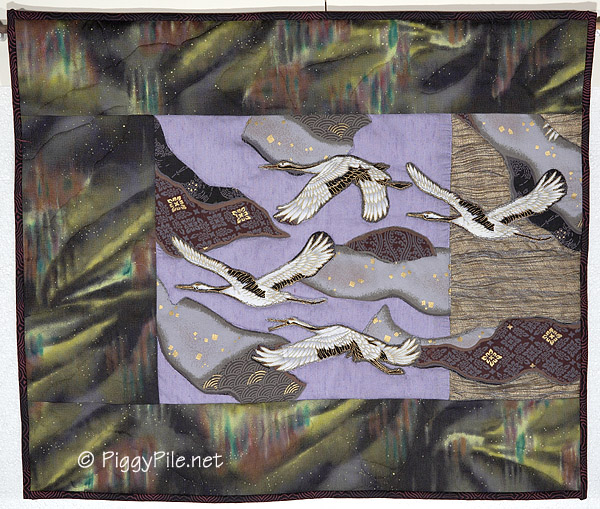
I made this small (19 x 22 inches) wall hanging in 2006. Some of the fabric in the center is the same as I used on the book. These aren't Sandhills, although if you possessed a "scope of imagination" like Anne of Green Gables did, you could pretend they were.
I fussy cut the cranes and swoopy "clouds" out of fabric, then appliqued them onto the lavender "sky".
On the right side, I sewed a strip of iridescent, crinkly fabric. More cranes and clouds are appliqued on this different texture.
We did so much walking this winter that I wore out a pair of boots. Here are my new boots that came in the mail yesterday. Although we're all looking forward to lots more walking and crane sightings, it won't be in these - they're too pretty to get dirty!
In honor of tomorrow's winter solstice, let's finish up the series of books I made on the solar system. We've already walked through the
planets based on their proximity to the sun, going from closest to
farthest:
What's left? The Sun, and the Solar System itself!
This is Sun. The book is on the left, the case for it is on the right. All the materials are, of course, warm colors. The swirls on the book and case evoke solar flares.
"Sun" buttons in the upper left and lower right.
Although the outside cover is square, all the pages are round. The blurriness on the right is caused by an overlay of fine mesh paper - interfering with communication just like solar flares and CMEs (read both pages for details).
This is the carrier for Solar System. The dark fabric is velvet, the stripes are satin.
Here is Solar System peeking out of the carrier.
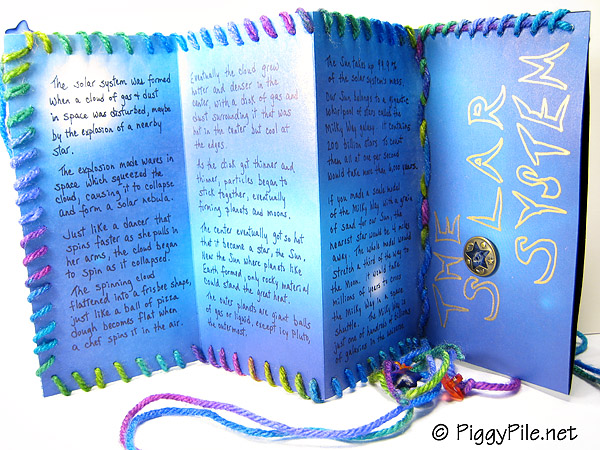
The inside pages...
There's an open pocket on the right where I tucked some special, secret treasures.
This is the bibliography showing all the books I referenced in writing my little series of books.
Each Thursday I'll feature items that have a similar theme. They might be quilts, books, or purses I made. Or, they might be ceramics or other objects (not made by me) related to the theme. If there are too many, I'll spread them out over multiple, but not always consecutive, posts.
Today we continue with a series of books I made on the solar system. We are walking through the planets based on their proximity to the sun, going from closest to farthest. In September, I introduced you to Mercury, Venus, and Earth. In October we visited Mars, Jupiter, and Saturn. Today's journey takes us to Uranus, Neptune, and Pluto.
Some of the books have riddles that I got from a children's book. Sometimes the riddles gave me ideas for what the book should look like. This is the cover of Uranus.
Now that you see the answer to the riddle, you can see (hopefully) that the form of the book is patterned after a Ferris Wheel. To turn the pages, you flip them over on the rings.
A better view.
This is the envelope for Neptune, with a water theme, of course. Lucky for me, the felt came with that shell embossing on the edge.
Cover of Neptune peeking out of the envelope.
Centerfold with stamps and buttons. The jumpy-things in the upper right are gummy candy. I bought them to put on some Fishbowl cupcakes inspired by the book Hello, Cupcake! - but I never got around to making them. Too busy making books.
This paper was nice and supple and I was able to sew it on my sewing machine. You may have noticed a line of stitching down the middle of the previous photo, and here you can see stitching on the edges. The orbs are the pages in the book.
To read the book, pull out an orb (one of Neptune's 16 moons) and turn it over.
This is a scary looking cover. Pluto is so far away and so cold, that I picked this stark-looking paper. I know that scientists don't consider Pluto to be a planet any more, but when I made the book there was still a healthy controversy.
Inside the book, back of the pages.
This is what it looks like as you flip through the book. All the pages have words on the back, but the way they are attached to the accordian fold you sometimes have text and sometimes just the cold, shiny, metallic backside.
There's still one final segment in this series. Look for it in December. Until then, happy star gazing!!!